
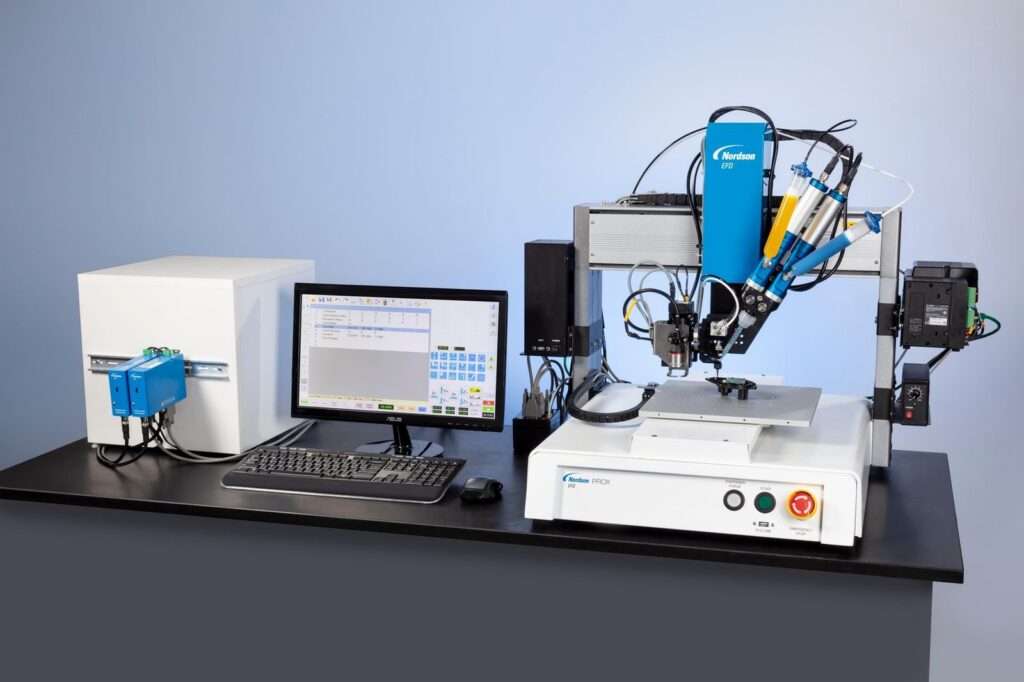
Last updated: November 2, 2026
Short answer: automate when the operator, not the fluid, has become the main source of variation. If deposits change from person to person or shift to shift, if patterns go beyond simple dots and lines, or if part counts are moving from dozens to thousands a day, a benchtop dispensing robot is usually the next step. Most shops get there in stages: hand application, then a pneumatic dispenser, then semi-automated batch work, then full integration on the line. You don’t have to skip any of them.
Nordson EFD describes a common path. An R&D engineer proves out a part with a squeeze bottle or a brush. Then production scales up, and repeatability becomes the problem: results depend on who is holding the tool. Each step below takes a bit more of that variation out of the operator’s hands.
The Four Stages of Dispensing
| Stage | What it looks like | Typical equipment | Signs you’ve outgrown it |
|---|---|---|---|
| 1. Hand application | Squeeze bottles, brushes, hand syringes | Manual syringe barrels and tips | Deposits vary with grip and fatigue; fluid waste and cleanup add up |
| 2. Pneumatic benchtop dispenser | Operator places each part and triggers a timed shot | Performus X, Ultimus, Ultimus V, UltimusPlus | Shot size is right, but placement isn’t; patterns are hard to hold by hand |
| 3. Semi-automated batch work | A benchtop robot runs a stored program over a fixture or tray of parts | EV Series or PRO Series robots with a dispenser, valve or jet | Loading and unloading the robot becomes the bottleneck |
| 4. Integration / full automation | Dispensing is one station on a conveyor, rotary table or pallet line | GV / GVPlus gantry robots, PLC-controlled valves and controllers | Usually the end state for high-volume lines |
Stage 2: Get the Benchtop Dispenser Right First
Many repeatability problems go away with a good pneumatic dispenser and the right components, with no robot needed. We start most customers on the Performus X line. If you need timed, repeatable shots across operators and shifts, step up to Ultimus. If your fluid thickens or thins during the shift, the Ultimus V can step its settings to compensate. If you need a log of every shot or PLC control, use UltimusPlus. Our Ultimus vs Performus vs UltimusPlus comparison covers the details. Before you blame the equipment, check the barrel, piston and tip; our fluid dispenser troubleshooting guide walks through it.
When a Benchtop Robot Makes Sense
A dispenser controls how much fluid comes out. A robot controls where it goes and in what path. Consider a robot when:
- Placement varies more than shot size. The deposit is the right size, but it lands in a slightly different spot on every part.
- Patterns are complex. Arcs, circles, compound arcs and beads that follow a part’s outline are hard to repeat by hand. Nordson EFD robots program dots, lines, circles and arcs in true 3D motion.
- Volume is climbing. Going from a few dozen to a few thousand parts a day is where operator-to-operator variation shows up.
- Quality wants proof. Vision alignment, tip detection and optional optical inspection give you a documented, repeatable process.
- Ergonomics. Long runs of fine work are hard on operators. A robot takes over the repetitive part of the job.
Stay manual when volumes are low, parts change constantly, or the work is still in R&D. A good benchtop dispenser is often the right tool there.
Which Nordson EFD Robot?
| Series | Axes | Programming | Best for |
|---|---|---|---|
| EV Series | 3 | DispenseMotion software with a pencil vision camera, mark recognition and DXF import | Batch work without precise fixtures; platforms from 200 × 200 mm to 620 × 500 mm |
| PRO / PROPlus / PROX | 3 | DispenseMotion with a CCD smart camera, closed-loop X/Y encoders and optional laser height detection | Tight placement over rough or uneven parts; the PROPlus is rated at ±0.003 mm repeatability per axis |
| 4-Axis PROPlus / RV Series | 4 | DispenseMotion | Parts that need rotation, by rotating table (PROPlus) or Z-axis rotation (RV) |
| GV / GVPlus Series | 3 | DispenseMotion with vision | Gantry robots for conveyor-fed production lines, and for heavy or large parts |
Specifications are from Nordson EFD product pages and the PROX / PROPlus / PRO Series operating manual. Per Nordson EFD, repeatability results vary with the measurement method.
Every Nordson EFD robot includes automatic tip detection, which corrects X, Y and Z after a tip change so you don’t have to reprogram. Per Nordson EFD, most users can work on their own with DispenseMotion after less than a day of training. On PRO Series systems, the camera compares each part to a stored reference image and corrects the dispense path for small shifts in position or rotation, so fixtures don’t need to be perfect. For more details, see Nordson EFD’s automated dispensing systems overview.
The Robot Carries Whatever Dispenses Best
A robot doesn’t replace your dispensing method; it carries it. The same robot can run a syringe-barrel dispenser such as the UltimusPlus, a dispense valve, a PICO jet valve or a 797PCP progressive cavity pump. Pick the dispensing method for the fluid first. Our valve systems page and hand-dispensing vs jetting cover that decision. Then pick the robot for the part, the pattern and the line.
Safety and Integration
Robots can run as standalone benchtop cells or as one station on an in-line transfer system, rotary table or pallet line, with I/O to connect accessories such as vacuum tables, UV lights and pick-and-place. Nordson EFD offers plug-and-play safety enclosures with a physical barrier and light curtain. They are CE-compliant and mandatory in Europe. Ask us what your plant’s safety team needs before you order.
Test Your Part Before You Commit
J.A. CRAWFORD CO. has helped manufacturers in Southern California, Arizona and Baja Mexico scale up their dispensing since 1967. As Nordson EFD Solutions Experts, we will look at your part, fluid and volumes, tell you plainly whether a robot is worth it or a better benchtop setup will do, and run your parts at our Santa Fe Springs, CA technical lab. See our automated dispensing systems page, browse fluid dispensers online, or email technicalservices@jacrawfordco.com or call 562-698-0901 to book an application test.
Frequently Asked Questions
When should I switch from manual to automated dispensing?
When the operator has become the main source of variation: deposits land in different places on each part, patterns are too complex to repeat by hand, or volumes are moving from dozens to thousands of parts a day. If shot size is the only problem, a better benchtop dispenser may be enough.
What is a benchtop dispensing robot?
A tabletop 3- or 4-axis robot that moves a dispenser, valve or jet over a part along a programmed path. Nordson EFD offers the EV, PRO, RV and GV Series, all programmed with DispenseMotion software.
Which Nordson EFD robot is easiest to program?
The EV Series pairs DispenseMotion software with a pencil vision camera, mark recognition and DXF import, so you can turn a drawing into a dispense program. Per Nordson EFD, most users work on their own after less than a day of DispenseMotion training.
Can I use my existing dispenser on a robot?
Nordson EFD robots are designed for Nordson EFD syringe barrel and valve systems. A syringe-barrel dispenser such as the UltimusPlus, a dispense valve, a PICO jet valve or a progressive cavity pump can all be mounted on the robot. Ask us to confirm your setup.
Do dispensing robots need a safety enclosure?
Nordson EFD offers CE-compliant enclosures with a physical barrier and light curtain, and they are mandatory in Europe. Requirements elsewhere depend on your plant’s safety rules.