
Last updated: October 28, 2026
Short answer: choose a Performus dispenser for general, reliable bench dispensing. Choose an Ultimus I or II when you need tighter digital control and operator lockout. Choose an Ultimus V when your fluid changes viscosity during the shift, as two-part epoxies and some UV-cure adhesives do. Choose an UltimusPlus when you need to document every shot or run the dispenser from a PLC. In every series, the “I” or “100” model (0–100 psi) handles most fluids, and the “II” or “15” model (0–15 psi) gives finer control of thin fluids.
All of these are air-powered (pneumatic) benchtop dispensers from Nordson EFD. All of them dispense from a disposable syringe barrel and tip, so they work with nearly any assembly fluid: adhesives, cyanoacrylates, epoxies, greases, oils, sealants, silicones and solder pastes. What sets them apart is how much control, memory and process documentation each one gives you. Below is how we help customers choose.
Nordson EFD Dispenser Comparison
| Model | Pressure range | Best for | Key features |
|---|---|---|---|
| Performus I | 0–100 psi (0–7 bar) | Operator-controlled dots, beads and fills where no timed shot is needed | Electric foot pedal, vacuum control to keep thin fluids from dripping |
| Performus X100 | 0–100 psi (0–7 bar) | Repeatable timed shots of most fluids | Teach function to set the first shot, Timed and Steady modes, vacuum control, I/O connection |
| Performus X15 | 0–15 psi (0–1 bar) | Thin fluids | Same as X100, with a low-pressure regulator for finer control |
| Ultimus I | 0–100 psi (0–7 bar) | Critical medical device and electronics work, any fluid | Digital display of all settings, time adjustment down to 0.0001 s, 16 stored programs, constant-bleed regulation, time lockout |
| Ultimus II | 0–15 psi (0–1 bar) | Critical work with low-viscosity or thin fluids | Same as Ultimus I, with low-pressure regulation |
| Ultimus V | 0–100 psi (0–7 bar) | Fluids that thicken over time or thin out as the room warms, such as two-part epoxies and UV-cure adhesives | 400 memory cells, Auto Increment mode to step parameters as viscosity changes, patterns of up to three shot sizes, RS-232 control, full lockout of time, pressure and vacuum, optional Optimeter for full-to-empty compensation |
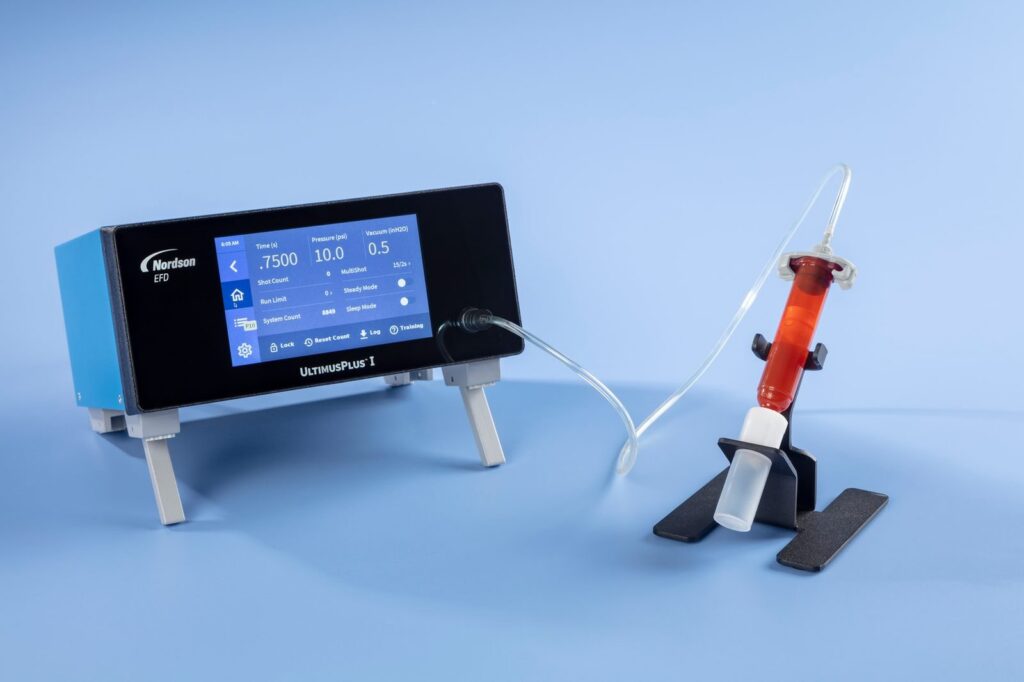
| UltimusPlus I | 10–100 psi (0.7–7 bar) | Regulated or documented processes, automated cells, smart factory setups | Touchscreen, calibration on every shot for first-shot accuracy, dispense log exported as CSV by USB or FTP, Ethernet/NX control from a PC or PLC, full lockout of time, pressure and vacuum, 16-program library |
| UltimusPlus II | 0.3–15 psi (0.02–1 bar) | The same, for thin fluids | Same as UltimusPlus I, with low-pressure regulation |
Specifications are from Nordson EFD product pages and operating manuals. The Ultimus and UltimusPlus series are rated at more than 600 cycles per minute.
How to Choose in Four Questions
- Does every shot need to be the same size? Start with the Performus X line for general bench dispensing. If you need timed, repeatable shots, use an Ultimus.
- How thin is the fluid? Watery fluids, solvents and thin cyanoacrylates are easier to control on a 0–15 psi model (Performus X15, Ultimus II or UltimusPlus II). Everything else goes on a 0–100 psi model.
- Does the fluid change while you work? If a two-part epoxy thickens through its pot life, or a UV adhesive thins as the room warms, the Ultimus V can step its settings automatically to keep deposits consistent.
- Do you need proof of what was dispensed? If quality or regulatory teams want a time-stamped record of time, pressure and vacuum for each shot, or engineering wants PLC control, go with UltimusPlus.
Performus vs Ultimus: What the Upgrade Gets You
Performus dispensers are reliable, simple workhorses. Ultimus adds a full digital display of every parameter, finer time adjustment (down to 0.0001 seconds), 16 stored programs and constant-bleed pressure regulation, which makes pressure settings more intuitive to adjust. That matters most when different operators on different shifts run the same part. Lockout keeps the settings from drifting, which reduces operator-to-operator variation.
Ultimus vs UltimusPlus: Calibration and Data
Traditional dispensers need periodic outside calibration to confirm that the displayed pressure matches what reaches the barrel. Per Nordson EFD, the UltimusPlus calibrates each dispense: if the screen says 10 psi, 10 psi goes to the barrel. That cuts setup time and gives first-shot accuracy. It also keeps a dispense log, with each entry date- and time-stamped, which teams use for batch traceability and process verification. If you are in medical device assembly or any audited process, this is usually the deciding factor. Calibrated versions (to EFD specifications based on NIST standards) are available for the Ultimus I and II and the UltimusPlus I and II.
The Dispenser Is Only Half the System
Every one of these dispensers performs only as well as the barrel, piston and tip on the other end of the hose. If deposits are inconsistent, check the components before you blame the dispenser. Start with our guides to syringe barrels, pistons and dispense tips, or see fluid dispenser troubleshooting.
Try Before You Buy
J.A. CRAWFORD CO. has served manufacturers in Southern California, Arizona and Baja Mexico since 1967 as Nordson EFD Solutions Experts. We will bring the dispensers to your bench, or you can test with your own fluid at our Santa Fe Springs, CA technical lab. Compare models on our fluid dispensers page, order online, or email technicalservices@jacrawfordco.com for a free demo.
Frequently Asked Questions
What is the difference between Ultimus I and Ultimus II?
The pressure regulator. Ultimus I regulates 0–100 psi (0–7 bar) and handles any fluid. Ultimus II regulates 0–15 psi (0–1 bar) for finer control of low-viscosity, thin fluids. The same I/II split applies to the UltimusPlus. On the Performus line it is the X100 and X15.
Which Nordson EFD dispenser is best for two-part epoxy?
The Ultimus V. Two-part epoxies thicken as they cure, so a fixed setting gives smaller shots over time. The Ultimus V stores up to 400 parameter sets and its Auto Increment mode steps through them to keep deposits consistent.
Which dispenser keeps a record of each shot?
The UltimusPlus. It logs dispense time, pressure and vacuum with a date and time stamp, and exports the log as a CSV file by USB or FTP.
Can an EFD dispenser be controlled by a PLC?
Yes. The UltimusPlus is network capable through Ethernet with NX protocol over TCP/IP, so a PC or PLC can change settings and monitor it remotely. The Ultimus V has an RS-232 interface, and the Performus X has an I/O connection.
What is the cheapest Nordson EFD dispenser?
The Performus I is the entry-level model for operator-controlled dispensing without a timed shot. For current pricing, see our online store or ask us for a quote.