
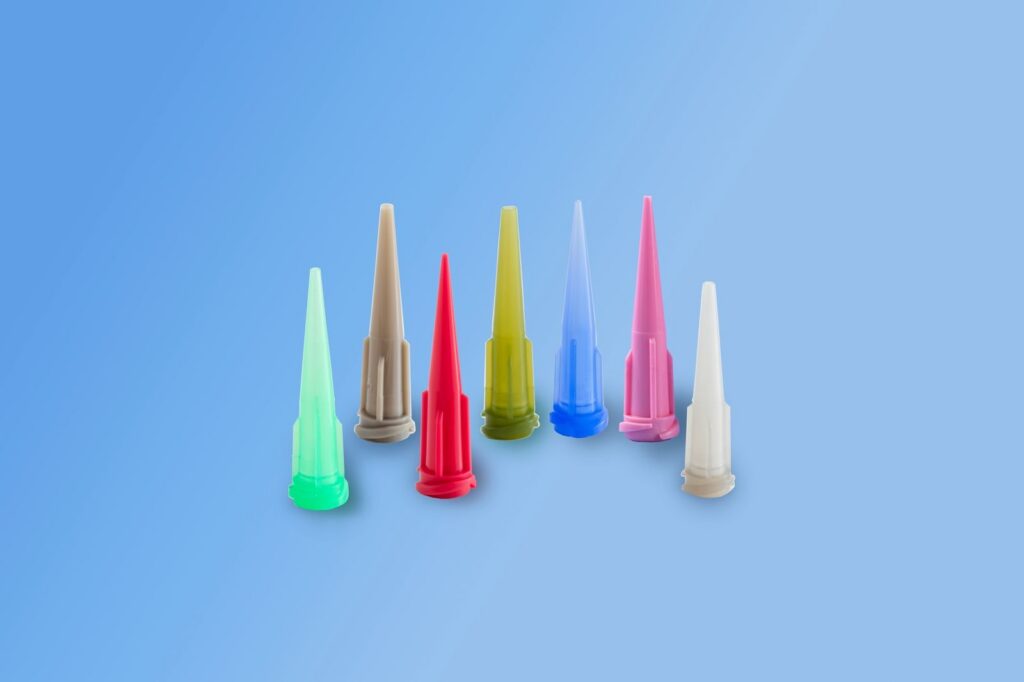
Last updated: October 28, 2026
Short answer: Nordson EFD Optimum dispensing tips are color-coded by gauge. The higher the gauge, the smaller the opening. A 14 gauge olive tip has a 0.060″ (1.54 mm) ID, and a 32 gauge yellow tip has a 0.004″ (0.10 mm) ID. The chart below gives the exact inner and outer diameters, taken from Nordson EFD’s published component specifications. To pick a size, aim for a tip ID about half the diameter of the deposit you want.
General Purpose Stainless Steel Tips
Passivated, burr-free stainless steel cannula in a polypropylene SafetyLok hub. Lengths: 0.25″, 0.5″, 1″ and 1.5″ (not every gauge in every length).
| Gauge | Hub color | ID (in) | ID (mm) | OD (in) | OD (mm) |
|---|---|---|---|---|---|
| 14 | Olive | 0.060 | 1.54 | 0.072 | 1.83 |
| 15 | Amber | 0.053 | 1.36 | 0.065 | 1.65 |
| 18 | Green | 0.033 | 0.84 | 0.050 | 1.27 |
| 20 | Pink | 0.024 | 0.61 | 0.036 | 0.91 |
| 21 | Purple | 0.020 | 0.51 | 0.032 | 0.82 |
| 22 | Blue | 0.016 | 0.41 | 0.028 | 0.72 |
| 23 | Orange | 0.013 | 0.33 | 0.025 | 0.65 |
| 25 | Red | 0.010 | 0.25 | 0.020 | 0.52 |
| 27 | Clear | 0.008 | 0.20 | 0.016 | 0.42 |
| 30 | Lavender | 0.006 | 0.15 | 0.012 | 0.31 |
| 32 | Yellow | 0.004 | 0.10 | 0.009 | 0.24 |
SmoothFlow Tapered Tips
Molded polyethylene with a gradual taper, for medium- to high-viscosity and particle-filled fluids. The colored standard tips contain a light-block additive for UV-sensitive fluids. Rigid opaque versions (polypropylene) block light for light-sensitive fluids.
| Gauge | Hub color | Outlet ID (in) | Outlet ID (mm) |
|---|---|---|---|
| 14 | Olive | 0.063 | 1.60 |
| 16 | Grey | 0.047 | 1.19 |
| 18 | Green | 0.033 | 0.84 |
| 20 | Pink | 0.023 | 0.58 |
| 22 | Blue | 0.016 | 0.41 |
| 25 | Red | 0.010 | 0.25 |
| 27 | Clear | 0.008 | 0.20 |
Same Color, Different ID: Watch the Tip Style
The hub color tells you the gauge, but the actual opening depends on the tip style. If you switch styles, check the ID, not just the color:
- Pink 20 ga: 0.024″ general purpose, 0.023″ tapered, 0.019″ flexible polypropylene.
- Red 25 ga: 0.010″ general purpose and tapered, 0.014″ flexible polypropylene.
- Amber 15 ga: 0.053″ general purpose, 0.049″ flexible polypropylene.
- Olive 14 ga: 0.060″ general purpose, 0.063″ tapered.
- PTFE-lined tips are specified by crimp ID: grey 0.020″ (0.51 mm) and pink 0.012″ (0.30 mm).
Values in this chart are for Nordson EFD Optimum tips. Other brands use their own charts and may not match.
Other Tip Styles and Their Sizes
| Style | Sizes (ID) | Use it for |
|---|---|---|
| Flexible polypropylene | 15 amber 0.049″, 18 green 0.033″, 20 pink 0.019″, 25 red 0.014″ | Hard-to-reach spots, dragging along edges, delicate surfaces |
| PTFE-lined (crimped) | Grey 0.020″, pink 0.012″ | Thin cyanoacrylates and micro-deposits of watery fluids |
| PTFE-coated | 21 purple 0.020″, 22 blue 0.016″, 23 orange 0.013″, 25 red 0.010″ | Stopping wicking and drips with thin fluids |
| Chamfered | 18 to 33 gauge | Thin fluids, and positioning between two surfaces |
| Ceramic MicroDot | 37 gauge, 0.002″ (0.05 mm) | Micro-deposits as small as 100 µm, including fine particle-filled fluids |
Our online store carries chamfered, bent and PTFE-lined tips. We can quote the rest of the Nordson EFD tip line.
How to Pick the Right Gauge
- Start with the deposit. Per Nordson EFD, the smallest deposit a tip makes is about twice its ID. So choose a tip with an ID about half the deposit diameter you need. For a 0.020″ dot, start with a 0.010″ (25 ga) tip.
- Adjust for the fluid. Thin fluids and cyanoacrylates spread more, so test from a 2:1 deposit-to-ID starting point. Very thick pastes may need a larger tip than the deposit math suggests, because a narrow cannula creates too much back pressure.
- Size for particles. For particle-filled fluids, choose an ID at least 10 times the particle size. A 20 µm particle needs at least a 200 µm (about 0.008″) ID. Go larger for high particle loading.
- Thick fluid? Go short, wide and tapered. Use the lowest gauge (widest ID) and the shortest length the part allows, in a tapered tip. If you need a long tip, compensate with a wider ID. If you need a small ID, keep it short.
- Then tune the dispenser. Shorter pulses make smaller deposits. Avoid running right at the dispenser’s minimum time, so you have room to adjust.
For choosing a tip style (tapered vs stainless vs PTFE), see how to choose a dispensing tip. For matching tips to specific fluids, see dispensing by fluid type.
Need a Sample?
J.A. CRAWFORD CO. stocks Optimum tips in Santa Fe Springs, CA and ships across Southern California, Arizona and Baja Mexico. Not sure between two gauges? Email technicalservices@jacrawfordco.com with your fluid and deposit size and we will help you test, or order dispensing tips online. See also our dispense tips and needles page.
Frequently Asked Questions
What color is an 18 gauge dispensing tip?
Green. A Nordson EFD 18 gauge tip has a 0.033″ (0.84 mm) ID in both the general purpose and SmoothFlow tapered styles.
What is the ID of a 16 gauge tapered dispensing tip?
0.047″ (1.19 mm). The 16 gauge grey hub is offered as a Nordson EFD SmoothFlow tapered tip.
Does a higher gauge mean a bigger or smaller tip?
Smaller. Gauge numbers run opposite to size: 14 gauge is 0.060″ ID and 32 gauge is 0.004″ ID on Nordson EFD general purpose tips.
What size dispensing tip do I need for my dot size?
Start with a tip ID about half the dot diameter you want, because a deposit is roughly twice the tip ID. Then fine-tune with pressure and time. Thin fluids spread more, so test.
Is a dispensing tip the same as a dispensing needle?
Yes. “Dispensing needle” is a common name for a tip with a narrow metal cannula. Industrial dispensing tips have blunt ends and are made for industrial use only.