
Last updated: October 28, 2026
Short answer: pick the barrel, piston and tip to suit the fluid. Thin fluids and cyanoacrylates need a blue LV Barrier piston, a PTFE-lined or crimped tip and a low-pressure dispenser. Thick and particle-filled fluids need a tapered tip and a piston that resists air bypass. UV-cure adhesives need an amber barrel and a UV-blocking tapered tip. RTVs and silicones need an orange Flatwall piston. The table below matches each common assembly fluid to the right Nordson EFD Optimum components, based on Nordson EFD’s published selection guide and FAQs.
We say “fluid is king” because the fluid decides almost everything else in a dispensing process. Use this as a starting point, then confirm with your fluid’s technical data sheet and a quick test.
Component Selection by Fluid
| Fluid | Barrel | Piston | Recommended tips | Avoid |
|---|---|---|---|---|
| Cyanoacrylate (thin) | Clear | Blue LV Barrier, set about 1″ above the fluid | PTFE-lined, tapered, flexible | Letting the piston touch the fluid |
| Cyanoacrylate (gel) | Clear | White SmoothFlow to start | Tapered (polyethylene), flexible | — |
| UV-cure adhesives | Amber | White SmoothFlow | Standard SmoothFlow tapered (UV-block) | Stainless or flexible tips without a tip shield |
| Light-sensitive adhesives | Black | White SmoothFlow | Rigid opaque tapered, or a tip shield over the hub | PTFE-lined. Stainless or flexible without a tip shield |
| Epoxies (1K and pre-mixed 2K) | Clear | White SmoothFlow, or beige if the epoxy is expensive | Tapered, stainless, flexible | PTFE-lined |
| Silver or particle-filled epoxy | Clear | Clear Flex at high pressure or cycle rates, beige to reduce waste | Stainless (chamfered is best), ceramic MicroDot | Tapered, PTFE-lined, flexible |
| Silicones and RTVs | Clear | Orange Flatwall | Tapered | PTFE-lined |
| Solder and braze pastes | Clear | Clear Flex at high pressure or cycle rates | Tapered, stainless | PTFE-lined |
| Greases | Clear | White SmoothFlow | Tapered, stainless, flexible | PTFE-lined |
| Oils | Clear | White SmoothFlow | Stainless, flexible | — |
| Solvents | Clear | Blue LV Barrier | Stainless, flexible, PTFE-lined. PTFE-coated or chamfered to stop wicking | Tapered |
| Anaerobics | Clear | White SmoothFlow | Tapered, flexible (plastic) | Metal MicroDot tips and precision nozzles |
| Conformal coatings | Clear | White SmoothFlow | Tapered | PTFE-lined |
| Hot melts | Unity HiTemp (up to 180 °C / 365 °F for 8 hours) | — | — | Standard barrels |
Tip ratings are from Nordson EFD’s Optimum Component Selection Guide and component brochure. Piston and barrel guidance is from Nordson EFD’s FAQs. “Avoid” lists the styles Nordson EFD rates as not recommended. Styles not listed are rated satisfactory.
Thin Fluids, Solvents and Cyanoacrylates
Low-viscosity fluids flow under gravity and react to the slightest pressure change. They need precise pressure plus a little vacuum after each shot to stop drips.
- Piston: the blue LV Barrier piston has the tightest fit and a small vent hole. It sits above the fluid rather than on it, so it doesn’t move as the level drops. That matters with cyanoacrylates: if the piston touches CA, it can bond to the barrel wall. Never use an orange flat-wall piston with watery fluids.
- Tip: PTFE-lined crimped tips resist CA clogging and slow the flow for control. For solvents, PTFE-coated or chamfered tips stop the fluid from wicking up the outside of the cannula. A cannula slightly larger than the minimum can reduce dripping.
- Air: moisture cures CA, so put a filter regulator with a coalescer on the air line, and use an adapter assembly with a filter trap to protect the dispenser from suck-back.
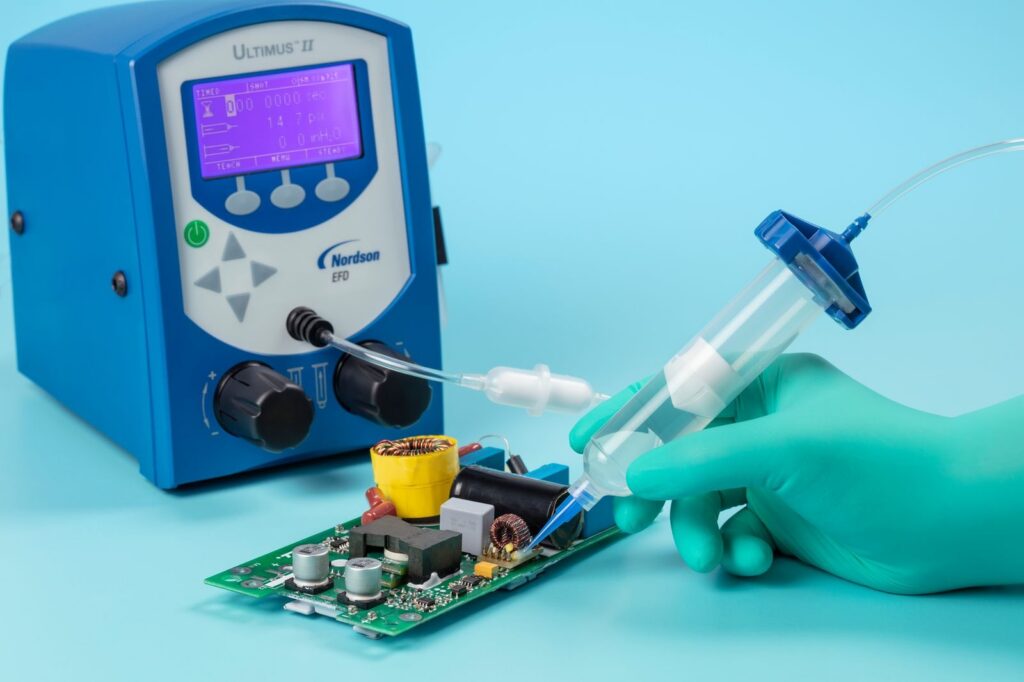
- Dispenser: a 0–15 psi model (Ultimus II, UltimusPlus II or Performus X15) gives finer control. See our dispenser comparison.
- Filling: fill CAs with a long-spout funnel, not tilt-and-pour, and keep fluid off the barrel walls and rim.
Thick Pastes and Particle-Filled Materials
Forcing a thick paste from a wide barrel into a narrow steel cannula creates back pressure. Turning up the pressure leads to poor control, excess deposits, and can separate filled materials in the barrel.
- Tip: a SmoothFlow tapered tip lets the paste flow smoothly. Nordson EFD reports pressure dropping from about 80 psi on a general purpose tip to about 30 psi on a tapered tip. Use the widest and shortest tip the part allows.
- Particle size: choose a tip ID at least 10 times the largest particle. Check the tip gauge chart for exact IDs.
- Piston: for high pressure or high cycle rates, the Clear Flex piston flexes to seal tighter and keeps air from getting under it (piston bounce).
- Exception: for silver-filled epoxy, Nordson EFD rates tapered tips as not recommended. Use stainless steel, ideally chamfered, or ceramic MicroDot tips.
- Filling: bottom-fill with an Atlas barrel filling system to avoid trapping air, and degas with a centrifuge if needed.
Silicones and RTVs
RTVs are thick, stringy and clumpy, so air tends to collect under a tight-fitting piston. The orange Flatwall piston leaves a small gap at the barrel wall so air escapes. Some residue on the wall is expected and is the trade-off for consistent deposits. Pair it with a tapered tip. Learn more in how to choose a syringe piston.
UV-Cure and Light-Sensitive Adhesives
Light reaching the fluid inside the barrel or tip hub can cure it before it ever reaches the part.
- UV-cure: use amber barrels, which block UV and visible light up to 550 nm while still showing the fluid level, and standard SmoothFlow tapered tips, which contain a UV-blocking additive.
- Visible-light-sensitive: use black barrels, which block all light, with rigid opaque tapered tips or a tip shield over the hub.
- Changing viscosity: UV adhesives can thin out as the room warms. The Ultimus V can step its settings to compensate.
See amber 10cc barrels, black 10cc barrels or our syringe barrel guide.
Epoxies
One-part and pre-mixed two-part epoxies dispense well through tapered, stainless or flexible tips. Avoid PTFE-lined tips. If the epoxy is expensive, the beige SmoothFlow piston’s tighter, dual-wiper fit leaves less behind in the barrel. Two-part epoxies thicken through their pot life, so a fixed time and pressure gives shrinking shots. The Ultimus V’s Auto Increment mode adjusts for that.
Need Help With Your Fluid?
Send us your fluid’s technical data sheet, the deposit size and the part, and J.A. CRAWFORD CO. will recommend the barrel, piston, tip and dispenser, then test it in our Santa Fe Springs, CA lab or on your bench. We serve Southern California, Arizona and Baja Mexico. Email technicalservices@jacrawfordco.com or order Optimum components online.
Frequently Asked Questions
What is the best dispensing tip for cyanoacrylate?
For thin cyanoacrylates, use a PTFE-lined crimped tip: the lining resists clogging and the crimp slows the flow. For gel cyanoacrylates, use a polyethylene tapered tip, which doesn’t react with CA.
What syringe barrel should I use for UV-cure adhesive?
Use an amber Optimum barrel, which blocks UV and visible light up to 550 nm. Pair it with a standard SmoothFlow tapered tip, which contains a UV-blocking additive.
Which piston should I use for RTV silicone?
The orange Flatwall piston. Its small gap at the barrel wall lets air escape so the piston doesn’t bounce on thick, stringy fluids.
Which piston is best for thin fluids?
The blue LV Barrier piston. It has the tightest fit and a small vent hole, and it sits above the fluid so the dispenser can switch between pressure and vacuum without moving it.
What tip should I use for solder paste?
A SmoothFlow tapered tip or a stainless steel general purpose tip, with an ID at least 10 times the largest particle size. Avoid PTFE-lined tips.