
Last updated: November 9, 2026
Short answer: match the valve to the fluid first, then to the deposit. For thin to medium fluids such as cyanoacrylates, anaerobics, solvents and UV-cure adhesives, start with a diaphragm valve (752V). For small, repeatable dots of thin fluids, use a needle valve (741V, or the xQR41 for microdots). For thick pastes, greases and RTVs, use a piston valve (725D) or the high-pressure spool valve (736HPA-NV). For thin coatings, use a spray valve (781S or 781Mini). For solder paste and particle-filled fluids, use an auger valve (794).
A benchtop dispenser pushes fluid out of a syringe barrel. A dispense valve does the same job on a line or a robot, fed from a larger reservoir, and it opens and closes on a signal from a controller. Nordson EFD describes a complete valve system as four parts: the valve, a ValveMate controller, a fluid reservoir and the dispense tip. Get the fluid-to-valve match right and the other three fall into place.
Nordson EFD Dispense Valve Comparison
| Valve type | Nordson EFD models | Typical fluids (per Nordson EFD) | What it does best |
|---|---|---|---|
| Diaphragm | 752V, 702 mini, 752HF | Activators, anaerobics, cyanoacrylates, fluxes, solvents, UV- and light-cure adhesives | Seal-less design with an inert diaphragm between the actuator and the fluid; fine flow control and positive shutoff |
| Needle | 741V, 741MD MicroDot, xQR41, xQR41V | Low- to medium-viscosity assembly fluids; xQR41V lists accelerators, marking inks, silicone oils, solvents and UV-cure adhesives | Small, tightly repeated deposits; the needle seats close to the tip, so almost no fluid sits between shots |
| Piston | 725D / 725DA | Brazing pastes, epoxies, greases, paste fluxes, RTVs, sealants, solder resists | Medium to thick fluids, with a small snuff-back at the end of each cycle to stop drips |
| High-pressure spool | 736HPA-NV | Adhesives, greases, sealants, silicones | Thick materials at fluid pressures up to 2,500 psi (172 bar), with adjustable stroke and snuff-back |
| Spray (LVLP) | 781S, 781Mini, 787MS MicroSpray | Activators, coatings, greases, inks, liquid fluxes, oils, silicones, solvents | Even coatings in round or fan patterns, with low-volume, low-pressure air that keeps overspray and mist down |
| Auger | 794 / 794-TC | Solder paste, silver epoxies, particle-filled materials, thermal interface materials (TIM) | Screw-feed dispensing that doesn’t damage the metal particles in filled pastes |
Fluid lists and specifications are from Nordson EFD product pages and data sheets. Always confirm against your fluid’s technical data sheet, or let us test it.
Diaphragm Valves: Thin, Reactive Fluids
The 752V is the general-purpose choice for most low- to medium-viscosity fluids. There are no dynamic seals to wear: a polymer diaphragm keeps the fluid away from the actuator, and the open/close stroke adjusts from 0.13 to 0.64 mm (0.005 to 0.025 in.) for a fast, clean cutoff. Per Nordson EFD, the standard valve opens in as little as 15 milliseconds and runs above 500 cycles per minute. With the BackPack actuator, which mounts the solenoid right on the valve, actuation drops to 5–6 ms and cycle rates reach 800 per minute.
Two variations are worth knowing. The 702 Series mini-diaphragm valve is about 60% smaller and 70% lighter than typical dispense valves, so it suits tight fixtures and lighter robot heads. The 752HF high-flow valve was built for UV-cure resins, with an unrestricted flow path that reduces turbulence and micro-bubbles.
Wetted materials matter here. Nordson EFD recommends acetal fluid bodies for UV-cure adhesives, anaerobics and cyanoacrylates that might react with stainless steel, and UHMW polyethylene wetted parts for anaerobic threadlockers and other reactive fluids.
Needle Valves: Small, Repeatable Dots
A needle valve pulls a needle back a set distance from its seat on each pulse, then closes it again. Because the needle seats in the tip adapter, almost no fluid is left between the seat and the tip opening. The 741V runs above 400 cycles per minute at fluid pressures up to 300 psi (20.7 bar).
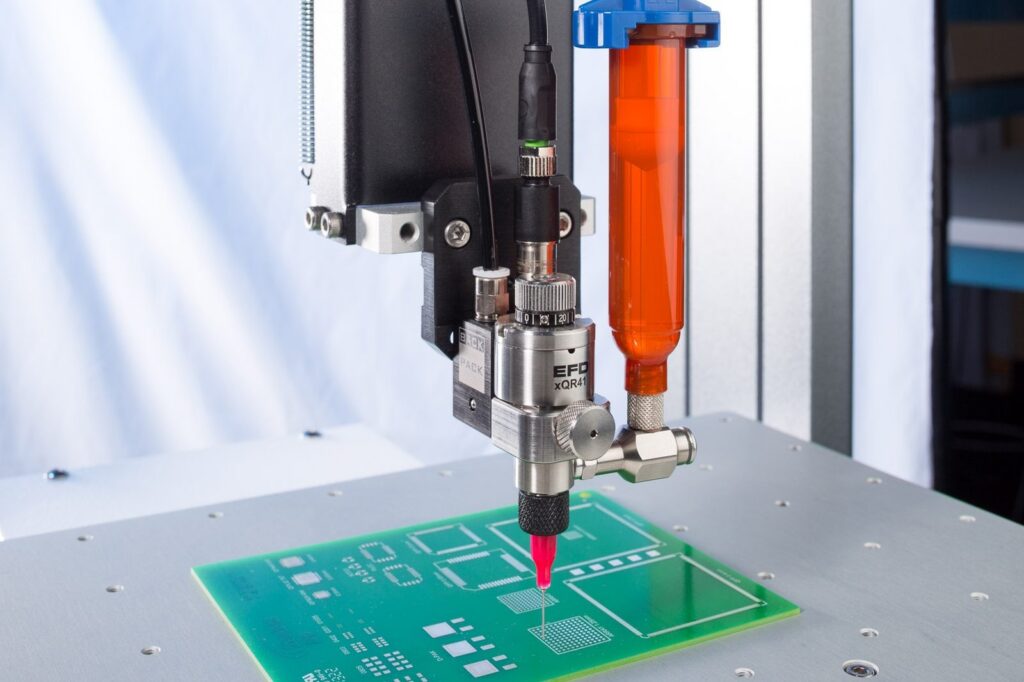
For very small deposits, step down to a MicroDot valve. The 741MD places deposits down to fractions of a microliter. The xQR41 places microdots as small as 150 µm (0.006 in.) in a body 60% smaller than conventional needle valves, and its tool-free Quick Release clasp lets you pull the fluid body for service in seconds. PEEK wetted parts are available for reactive adhesives such as anaerobics. If you need larger deposits, lines or a wider range of tips, including SmoothFlow tapered tips, the xQR41V covers a wider viscosity range with the same clasp. Tip choice still sets the floor on deposit size; see our dispensing tip gauge chart.
Piston and High-Pressure Valves: Thick Pastes
When the fluid is too heavy for a diaphragm, look at the 725D piston valve. A UHMW diaphragm isolates the wetted parts from the actuator for long wear, and a slight snuff-back at the end of each shot keeps the tip from dripping. The adjustable 725DA lets you tune both flow and snuff-back. For the thickest greases and silicones, the 736HPA-NV handles fluid pressures up to 2,500 psi with a coated spool, adjustable stroke to keep dot and bead profiles consistent, and an air-assisted closure.
Spray Valves: Coatings, Not Dots
If the job is to coat an area rather than place a deposit, use a spray valve. The 781S uses low-volume, low-pressure (LVLP) air with separate fluid and nozzle-air adjustment. Per Nordson EFD, it covers round patterns from 4.3 to 50.8 mm (0.17 to 2.0 in.) and fan patterns up to 165 mm (6.5 in.) wide. The 781Mini is 60% smaller and sprays patterns as narrow as 1 mm (0.04 in.). The 787MS MicroSpray uses a small-gauge disposable tip in place of a nozzle for patterns from 3.3 to 19 mm. Spray valves pair with the ValveMate 8040 controller. For conformal coating defects, see our guide to reducing voids and bridging in PCB conformal coating.
Auger Valves: Solder Paste and Filled Fluids
Particle-filled pastes can separate or get damaged under the wrong kind of pressure. The 794 auger valve uses a screw feed with time and pressure control to place consistent deposits without crushing the metal particles in solder paste and silver epoxy. For abrasive thermal interface materials, the 794-TC has tungsten carbide wetted parts. Both run on the ValveMate 7194 controller and can feed from prefilled syringe barrels or cartridges.
Don’t Forget the Controller
Deposit size comes from fluid pressure, valve stroke, tip size and valve open time. Nordson EFD notes that open time gives you the most control of the four, which is why the controller matters. The ValveMate 7100 runs a single valve and adjusts open time in 0.001-second steps. The ValveMate 8000 runs up to four valves, independently or together. Both connect easily to a PLC. Browse all valve controllers.
Valve, Dispenser or Jet?
If parts are loaded by hand and each operator controls the shot, a benchtop dispenser is usually simpler; start with our Ultimus vs Performus vs UltimusPlus guide. Valves make sense when fluid comes from a bulk reservoir, when a machine or benchtop robot triggers the shot, or when several heads run at once. If throughput or non-contact placement is the issue, read hand-dispensing vs jetting and see our jet valve systems. Not sure where your fluid fits? Our dispensing by fluid type guide maps common fluids to the right components.
Get the Valve Matched to Your Fluid
J.A. CRAWFORD CO. has helped manufacturers in Southern California, Arizona and Baja Mexico choose dispense valves since 1967. As Nordson EFD Solutions Experts, we will review your fluid’s data sheet, suggest the valve, controller and reservoir, and test your fluid at our Santa Fe Springs, CA technical lab. See our valve systems page, order valves online, or email technicalservices@jacrawfordco.com or call 562-698-0901.
Frequently Asked Questions
What is the difference between a needle valve and a diaphragm valve?
A needle valve opens by pulling a needle off its seat near the tip, which gives very small, tightly repeated deposits with almost no fluid left between shots. A diaphragm valve uses a flexible polymer diaphragm between the actuator and the fluid, with no seals to wear, and suits thin, reactive fluids such as cyanoacrylates, anaerobics and UV-cure adhesives.
Which dispense valve is best for cyanoacrylate?
Nordson EFD lists cyanoacrylates as a compatible fluid for the 752V diaphragm valve. For UV-cure adhesives, anaerobics and cyanoacrylates that might react with stainless steel, Nordson EFD recommends an acetal fluid body.
Which valve should I use for grease or silicone?
For medium to thick greases, RTVs and sealants, use the 725D piston valve. For the thickest greases and silicones, the 736HPA-NV high-pressure valve handles fluid pressures up to 2,500 psi (172 bar).
Can a dispense valve handle solder paste?
Yes. The 794 auger valve is built for solder paste, silver epoxies and other particle-filled fluids, and places deposits without damaging the metal particles. The 794-TC version, with tungsten carbide wetted parts, is for abrasive thermal interface materials.
Do I need a controller for a dispense valve?
Yes. A ValveMate controller sets valve open time, which is the main control of deposit size. Use the ValveMate 7100 for one valve, the 8000 for up to four valves, the 8040 for spray valves and the 7194 for auger valves.